Anavex Ny tråd feb. 2023 - Nyt Parkinsonforsøg i Australien!
-
Det er da først efter at jeg spørger, at det bliver kommenteret at det endnu ikke vides. Det er derfor at jeg beder om at det bliver udpenslet til en anden gang. Jeg er givet vel farvet af at have læst indlæg på Ihub, Twitter, Facebook og her hvor det flere steder fremgår som stensikkert at Anavex deltager med et indlæg.
Jeg frygter at snakken om AAIC blot er et håb som ikke materialiserer sig, men vi får at se. Det viser endnu engang hvor ringe Anavex IR er.
I lige måde

-
Igår udkom der en ny artikel hos Seeking Alpha fra Lane Simonian som kan anbefales at læse.
Lad os håbe at han har ret i følgende.
Anavex has stated that its phase 2b/3 clinical trial results complement and are consistent with its phase 2a trial results. For those who were not titrated down, the company most likely knows that the 50mg group (which largely corresponds to the high concentration group in the phase 2a trial) did better than the 30mg group in the phase 2b/3 trial. Why Anavex still has not provided data for both groups (after untangling the titration issue) remains a mystery. It could be that Anavex is concerned that the number of participants remaining in the 50mg after dropouts and down titrations is not large enough to gain full approval from the Food and Drug Administration (FDA). The FDA could still grant accelerated approval allowing for the sale of blarcamesine while requiring a larger (and perhaps more lengthy trial) to firmly determine efficacy and safety. Anavex may also approach other regulatory agencies in Australia and Europe, for example, before or while engaging with the FDA in hopes of earlier approvals there.
-
Sund livsstil og sygdomsbekæmpelse er big business - men er det også værd at investere i? Bodil Johanne Gantzel spørger de to erfarne investorer, Lau Svenssen og Helge Larsen, der i studiet stiller op til debat om både den aktuelle markedsstemning og mulige interessante investeringer på lidt længere sigt.
Du kan i dagens afsnit høre mere om blandt andre Bakkafrost, Mowi, Grieg seafood. Nordic Halibut, Anavex, Genmab, Brain+, INSW, Norden, Pfizer, Novo Nordisk, Siemens Energy, Mercedes Benz Group, Ambu, Mærsk og Biogen.Podcast: https://www.euroinvestor.dk/podcast/millionaerklubben-der-er-penge-i-sundhed
-
Tak Helge for omtalen af Anavex, selv om du selvfølgelig skulle advare omkring early stage virksomhed og US biotech generelt.
Lytter man til direktøren i Anavex, så bliver han mere og mere selvsikker. Han utrykker sig bl.a. om, at firmaet nu er parat til at være kommerciel.
På kommende gf bliver ny formand for den nyetablerede bestyrelse kørt på plads.
Spændende profil:
https://stocktwits.com/Trainguy1/message/526623559Den kommende frigivelse af 50 mg gruppen i AD fase 2b/3 tror jeg bliver signalet til shorternes overgivelse og gerne massakre.
AAIC medio Juli en mulig begivenhed eller evt. noget i forbindelse med regnskabet i morgen.
Vi kommer tættere på hver dag
-
Anavex Q2 rapport.
Har 153,5 mill. $ på bogen pr. 30. marts 2023 (øget fra 149,2 mill. $) - stadig ingen gæld!

Anavex Life Sciences Reports Fiscal 2023 Second Quarter Financial Results
Newly available preliminary efficacy results of surrogate biomarkers from the ANAVEX®2-73-AD-004 study; allowing initiation of discussions with regulatory agencies for Accelerated Approval Pathway for ANAVEX®2-73 (blarcamesine) in Alzheimer’s disease with convenient oral treatment On track to

Stock Titan (www.stocktitan.net)
Positiv webcast, dog uden nogen kritiske spørgsmål.
Igen ingen angivelser af tidpunkter for de forskellige milepæle.Missling bekræfter, at man på baggrund af at andre selskaber har opnået acc. godkendelser på baggrund af biomarkører i Alzheimer, så agter Anavex at gå samme vej med de sidste nye positive resultater.
Får Anavex en acc. godkendelse, så kan man få 2-73 på markedet mens man udfører et P4 kontrolforsøg.Så alt tegner positivt - men Anavex er nok begrænset af at kunne uddybe tingene, indtil de komplette AD data offentliggøres i en Peer Review.
Tålmodighed endnu en gang!
-
Anavex 10 Q rapport for Q2 - 2023.
Solgte aktier under Lincoln Park aftalen:
2.075.000 aktier til kurs 8,75 $.
Forsætter den fornuftige strategi med at have ca. 150 mill. $ på bogen - giver handlefrihed til udvikling, produktion og til at få produkterne på markedet, uden at være afhængig af BP mm.
Hele 131 mill. $ må der om nødvendig endnu hentes i aftalen - burde være tilstrækkelig indtil vi forhåbentlig snart får indtægter fra evt. salg af 2-73.
Fratrækkes beholdningen, så er hele Anavex`s Pipeline værdiansat til 570 mill. $ - til sammenligning øgede LLY deres MC med hele 22 milliarder $ på deres fase 3 data i AD, hvor 31 % skal forvente hjerneblødninger ved en moderat forbedring af AD symptomer?During the six months ended March 31, 2023, the Company issued to Lincoln Park an aggregate of 2,159,080 (2022: 0) shares of common stock under the 2023 Purchase Agreement, including 2,075,000 (2022: 0) shares of common stock for an aggregate purchase price of $18,152,500 (2022: $0) and 9,080 (2022: 0) commitment shares.
At March 31, 2023, an amount of $131,847,500 (September 30, 2022: $0) remained available under the 2023 Purchase Agreement.
Eneste deltagende analytiker Jones Trading hævede deres kursmål fra 54 $ til 58 $.
https://www.tipranks.com/stocks/avxl/forecast -
Kopieret fra et indlæg på Ihub:
Tom Bishop talked to Anavex post CC. Here are his comments.
Anavex's (AVXL $9.20, +9%) (... and wow, Aris is up 25% this morning, I'll hit that next!) quarterly release and conference call was this morning. And after speaking with the Company and clarifying a few issues, there were some exciting revelations. First and foremost, the Company now believes, after 5 months of evaluating the data, that the data from the resent Phase 2b/3 Alzheimer's trial, and especially the data from the improvement in surrogate biomarkers that are associated with the pathology of Alzheimer's are strong enough that it intends to apply to the FDA for approval of A2-73 based on the "Accelerated Approval Pathway." Now this doesn't just mean the process moves along more quickly while it now does a full phase 3 trial. This means conditional approval for commercial sale of A2-73 based on the data already collected from the Phase 2b/3 trial, especially that based on improvement in the various Alzheimer's disease pathology biomarkers, along with the cognitive and other improvements in functional data itself. And then a confirmatory study would be done while the drug is already approved. Recent Alzheimer's drug approvals (Biogen and Lilly) have all utilized this pathway and evidence of improvement of various biomarkers for Alzheimer's disease. So this is rather exciting as there is a reasonable chance now that the Company could get approval relatively soon without waiting to first conduct a full blown Phase 3 trial. No guarantees on this, but very encouraging re the potential time line to market acceleration. Here is something more on this pathway-"The pathway specifically allows FDA to approve drugs based on a determination that the product has an effect on certain surrogate endpoints or intermediate clinical endpoints. Surrogate or intermediate endpoint can be based on a laboratory measurement (like blood glucose level for diabetes), radiographic image (like tumor size reduction), physical sign (like blood pressure for cardiovascular disease) or other measure. For instance, reduction of viral load in HIV patients, reduced tumor size in cancer patients or alleviation of symptoms can all be used to show a treatment's benefit to patients. Congress has clarified, through statute, that the accelerated approval pathway does not alter the standards of evidence required for approval.
After a medicine is granted accelerated approval, companies are required to conduct, and provide updates on, confirmatory trials and the FDA is required to make this information publicly available.
Companies are required to conduct confirmatory studies of medicines granted accelerated approval and are subject to reporting requirements on the status of these studies. The FDA is required to track, and make publicly available, progress of confirmatory trials."Remember that the safety data is much better than those Alzheimer's drugs recently approved that can cause brain swelling/bleeding (maybe even death) and the need for periodic/expensive MRI's to monitor this. AND A2-73 is an oral formulation not infusion therapy. So all things being equal, what are you gonna take?
Now the other cool thing here is, as announced in a press release last week, the Company has filed for a patent covering A2-73's use to lower high blood pressure. As you might expect, when patients came in for periodic trial evaluations, they got their blood pressure taken. And the Company noticed that those coming in with high blood pressure saw that drop back into the normal range! So while the Company is a ways off from pursuing this indication on its own, if it can claim this side benefit, in addition to the Alzheimer's benefits above ... like I said, which one are you gonna choose? Duh. (I also recall some potential benefits regarding improved sleep, I hope we get data on that also.) It's like how they have discovered lately that some of the diabetes drugs (Eli Lilly's in particular)) cause significant weight loss! So now these diabetes drugs are in short supply because other people are taking them just for weight loss. So A2-73, if approved, could then potentially be prescribed off label for blood pressure, or at least more likely advertised as a side benefit. The blood pressure data has not been disclosed but perhaps will be in the full release in a medical journal that will cover all the things we have been waiting for (30 vs. 50 mg, ADL and COG, sigma1 normal gene vs. the variant, all the other biomarker data ... ).
Elsewhere, I believe they are at last getting very close to announcing the Phase 3 Parkinson's disease trial initiation, in addition to the full A2-73 data release, plus in H2 the Rett Pediatric data. While this seems to move very slowly the Company is meticulous in its approach, avoiding the pitfalls so many companies fall into with their failed clinical trials and I would remind everybody once again that they have never failed one of their clinical trials. They have all been successful in showing efficacy, and that consistency itself tells you something. Small wonder Dr. Missling reiterated in closing that "... looking forward we're very excited about the Company's potential as well as to build the bio-marker driven precision medicine studies..."
There was more meat on the bone than today's stock market reaction gives credit for (it was down in the pre-market but I see as I finish this that it is now up 8%, still ... plenty of room ahead)- Buy. -
God morgen fra Thailand.
Her er mere fra Tom Bishop:

(05/17/22) Anavex: Drug Pipeline Progress
Anavex (AVXL) released its Q1 results and went through the list of projects currently in the pipeline, reports Tom Bishop, small cap expert and editor of BI Research.
(05/17/22) Anavex: Drug Pipeline Progress (www.moneyshow.com)
Han er positiv og det er jeg også.
Vi kommer langsomt tættere på en godkendelse og jeg er overbevist om at den kommer, måske RETT først?
-
Ja helt enig Fandel er dog lidt i tvivl om hvordan de vil prissaette 2-73 i de sjældne sygdomme hvis de er godkendt for AD og de som et eksempel tager 12.000$ om året for en daglig pille? Missling har nogle meget høje tal for RETT behandling, var det ikke 140.000 eller 170.000$ om året? Det kan han nok ikke forlange hvis AD er godkendt og meget billigere for behandling.
Her er en ret interessant artikel med navnet: Targeting Sigma Receptors for the Treatment of Neurodegenerative and Neurodevelopmental Disorders
Anavex's 2-73 og 3-71 er nævnt ret prominent.
https://link.springer.com/article/10.1007/s40263-023-01007-6#Sec13
-
Anavex Ny positiv artikel fra vores Lane Simonian Seeking Alpha.
Lane Simonian er stadig meget positiv på Anavex.
Hvis Misslings udsagn om, at de udspecificerede resultaterne i AD fase 2/3 forsøget er helt i tråd med det tidligere meget positive fase 2a forsøg, så får Anavex sandsynligvis en acc. markedsgodkendelse af FDA - og andre myndigheder.
Udsagnet blev gentaget på seneste webcast - så vi kan "koge" det ned til om vi kan stole på Missling eller ej?
Kan bare ikke se, hvordan han ville kunne slippe afsted en sådan gentagende udmelding, hvis det ikke havde sin rigtighed - der er jo også en bestyrelse bagved, som har et medansvar for disse udtalelser!Afventer primært det lovede Peer Review i et anerkendt fagblad!
"The Future
Anavex's CEO Christopher Missling has recently promised to release a clear, detailed analysis of the effects of blarcamesine based on dose. He also said that the phase 2b/3 results are consistent with and complement the phase 2a results. If that is the case those on the 50mg dose of Anavex should perform similar to those in the high concentration group in the phase 2a trial who had mild cognitive impairment or mild Alzheimer's disease and who did not have a "negative" sigma-1 gene variant (an approximate 2.9 point improvement in ADAS-Cog11 scores). That along with good biomarker data should be enough for the FDA to grant accelerated approval for the drug for early stage Alzheimer's disease at least in those who have a fully functioning sigma-1 receptor. Anavex could then sell blarcamesine while it runs a confirmatory trial. And if this is indeed what happens, Anavex is in good shape."
Hvis linket skulle fejle:
Cassava Sciences' Simufilam, Anavex's Blarcamesine, And Aricept: Shared Mechanisms Of Action In The Treatment Of Alzheimer's Disease
May 16, 2023 2:56 PM ETCassava Sciences, Inc. (SAVA)AVXL34 Comments
Lane Simonian profile picture
Lane Simonian
2.36K Followers
SummaryBlarcamesine, Aricept, and most probably simufilam are sigma-1 receptor agonists.
Sigma-1 receptor agonists often produce temporary improvements in cognition for those with mild cognitive impairment and can initially stabilize the disease in mild Alzheimer's disease patients, but not thereafter.
Blarcamesine appears to nearly stabilize mild Alzheimer's disease over longer periods of time than other sigma-1 receptor agonists, perhaps because it is acting as a direct antioxidant.
Cassava Sciences faces charges of data manipulation, staged the results of its early trial, and probably has an incorrect mechanism of action, and yet the results might be just good enough for FDA approval.
Based on yet still publicly unreleased biomarker data and dose dependent responses, the FDA could grant accelerated approval to blarcamesine.Recently, I compared the relative effectiveness of Anavex's (AVXL) blarcamesine, Cassava Sciences' (NASDAQ:SAVA) simufilam, and Aricept for the treatment of Alzheimer's Disease (article). I noted that blarcamesine and Aricept were sigma-1 receptor agonists and that simufilam was likely a sigma-1 receptor agonist. In this article, more conclusive results of the latter will be provided. Given the same mechanism of action the results for simufilam, blarcamesine, and Aricept should be about the same. The difference is that if blarcamesine also acts as a direct antioxidant, it should slow the advance of Alzheimer's disease during its earlier stages for a longer period of time than simufilam and Aricept. If so, Anavex would have a better treatment and represent a better investment than Cassava Sciences.
In addition to a discussion of the science, I will review recent developments for both companies.
Blarcamesine, Simufilam, and Aricept: A Shared Mechanism of Action
Both blarcamesine and simufilam are methyl amines (N-CH3), and methyl amines appear to be sigma-1 receptor agonists (analysis, alkyl/methyl amines). Aricept/donepezil has also been identified as a sigma-1 receptor agonist. About 20 percent of the population does not have a fully functioning sigma-1 receptor, so they receive very limited benefit from drugs that act as sigma-1 receptor agonists. Also sigma-1 receptor agonists become less effective as Alzheimer's disease progresses as protein kinase C which initially drives the disease becomes inactivated due to nitration (sigma-1 receptor agonists inhibit intracellular calcium release which in part limits the activation of protein kinase C). By contrast, most people with functioning sigma-1 receptors and with mild cognitive impairment or mild Alzheimer's disease benefit from these agonists because early on they reduce acetylcholinesterase activity, reduce the production and aggregation of amyloid and the phosphorylation of tau (study), and most importantly lessen oxidative stress and neuroinflammation (figure three).
Significant (some might say remarkable) improvements in individuals taking Aricept, simufilam, and blarcamesine have been reported. In addition, each drug improves cognitive function by a possibly clinically significant 4 points or more on the Alzheimer's Disease Assessment Scale-Cognition (ADAS-Cog) in some Alzheimer's patients (Aricept, simufilam, blarcamesine). The percentage of people who improve by this amount vary depending on the length of the study and baseline scores, but especially early on sigma-1 receptor agonists can temporarily modify disease progression (for example, 68% of those with mild cognitive impairment on simufilam improved at one year, but only 47% improved after the additional inclusion of mild to moderate Alzheimer's disease patients). Following is a comparison of the impact of these sigma-1 receptor agonists on Alzheimer's disease.
Simufilam versus Acetylcholinesterase Inhibitors (including Aricept) for mild Alzheimer's disease (mean change in ADAS-Cog11 scores)
Simufilam: 19.1 to 19.6
Acetylcholinesterase Inhibitors: 21 to 22.5
There is about a .7 point increase in decline for each change in ADAS-Cog scores for simufilam (from a 2.4 improvement from a baseline of 15 to a 4.4 point decline from a baseline of 25.7). So a close apples to apples comparison would be the following:
Simufilam: 21 to 22.4
Acetylcholineserase Inhibitors: 21 to 22.5
There is little to distinguish simufilam from acetylcholinesterase inhibitors in the treatment of Alzheimer's disease.
Simufilam versus Blarcamesine
The comparison between simufilam and blarcamesine becomes somewhat murkier. In its phase 2a trial, participants with the highest concentrations of the drug, who had mild cognitive impairment or mild Alzheimer's disease, and who did not have a sigma-1 receptor gene variant experienced a 1.7 point improvement in Mini-Mental State Examination (MMSE) scores at 57 weeks which is roughly the equivalent of a 2.9 point improvement in ADAS-Cog11 scores. If Cassava Sciences had only included the same populations, the results may have been close to the same.
Even after dealing with confounding variables such as different baselines, timelines, and genetic make-ups, the impact of sigma-1 receptor agonists on Alzheimer's disease appear similar: they can lead to temporary improvements in those with mild cognitive impairment, they can stabilize for about a year those with mild Alzheimer's disease, and they have a minimal impact on those with moderate and severe Alzheimer's disease.
Cassava Sciences: Pitfalls and Landmines
Mechanism of Action
Cassava Sciences touted a recent cancer study for having validated its proposed mechanism of action for simufilam. The researchers who conducted the study, instead, discovered a significantly different mechanism of action for simufilam: the drug reduced the phosphorylation of filamin A rather than restored it to its normal form. One might argue this newest finding is actually good news for Cassava Sciences since in theory reducing the phosphorylation/misfolding of proteins should provide a more effective treatment for Alzheimer's disease than unfolding them. The problem, however, is that misfolded proteins such as amyloid and filamin A are at best secondary contributors to Alzheimer's disease early on, so reducing their phosphorylation would have very little impact on the progression of the disease. Moreover at the very earliest stages of the disease a considerable amount of "toxic" phosphorylated/soluble filamin A has already been converted into non-toxic insoluble filamin A, so targeting the production of phosphorylated filamin A may not be effective at all (study). In short, the main beneficial mechanism of action of simufilam- likely its only beneficial mechanism of action - is as a sigma-1 receptor agonist.Legal Troubles
A Federal judge in Texas recently allowed a lawsuit against Cassava Sciences to go forward. The most serious allegation in the lawsuit is that Cassava Sciences' management/team manipulated phase 2b data (specifically removing a tau outlier from the drug group) and then set up large cash bonuses for themselves tied to rises in the stock's value (trial record, pp. 5-6). The plantiffs while acknowledging that Barbier and other Cassava executives did not collect on these bonuses, argued that the company still benefitted from the subsequent rise in stock prices (trial record, pp. 24-25). The exact legal jeopardy that Cassava's management team is in will not be known until the end of the trial.Staging of the Disease
In its open label trial, Cassava Sciences staged the disease such that the first fifty patients with mild cognitive impairment/amnestic cognitive impairment/prodromal Alzheimer's disease were processed first whereas the results for the last group which had late mild to early moderate Alzheimer's disease was not announced until 16 months later. The first fifty patients improved by a mean of 3.2 points at one year (2.4 points after further adjustment) whereas the last fifty patients declined by 4.4 points (press release). In between, Cassava Sciences averaged the scores for those with mild cognitive impairment with those who had mild Alzheimer's disease, possibly to try to obscure the small decline in the latter group. The company, thus, left the impression for months that individual with mild to moderate Alzheimer's disease had improved by 3.2 points at one year which would indeed have been remarkable achievement if it had been true. As it turned, individuals with less advanced mild Alzheimer's disease declined by .5 points and those with late mild to early moderate Alzheimer's disease declined by 4.4 points. This again is very similar to what one would expect with Aricept (article).Projections
If Cassava Sciences has not truly randomized its Cognition Maintenance Study but instead continued those with the least cognitive impairment on the drug and switched those with the most cognitive impairment onto the placebo, then the results will be meaningless. If a baseline ADAS-Cog score is not provided for both groups that would be a strong indication that results are not reflective of a randomized trial. Simufilam will almost certainly perform better than the placebo groups in its two phase 3 clinical trials but the question is whether it performs the same or better than the current standard of care (acetylcholinesterase inhibitors) for early stage Alzheimer's disease from one year to 18 months.
Given the added uncertainty of how the legal case against Cassava Sciences will be decided, it is hard to project the company's future stock value. High expectations of full exoneration and great future results by a very loyal investor base and further purchases by insiders may keep the stock in decent shape until the phase 3 clinical trial results are released. Those expectations may be partially dashed. However, despite all its baggage, Cassava Sciences may have a drug that has equal efficacy but perhaps less side effects than acetylcholinesterase inhibitors, and thus gain FDA approval. Hence the hold rating.
Anavex: Omissions and Potential
Omissions
Anavex should have provided a mean change in activities of daily living score at its Clinical Trials on Alzheimer's Disease (CTAD) presentation in December 2022. The company could also have provided the data for those maintained on the 30mg dose and the 50mg dose. Anavex did not provide details on rare side effects caused by the drug nor has it specified the severity and duration of the two main side effects: dizziness and confusion. Some or all of this information may be forthcoming later this year.Mechanism of Action: Antioxidants Can Make a Difference
Anavex notes that Anavex 2-73/blarcamesine reduces oxidative stress and inflammation in Alzheimer's disease (during its early stages). This is consistent with the action of sigma-1 receptor agonists. The company has never stated that blarcamesine is a direct antioxidant.Blarcamesine is a tetrahydrofuran derivative whose antioxidant capacity is uncertain. The best case that can be made that tetrahydrofurans are strong antioxidants is that they are ready hydrogen and oxygen donors which is precisely what is needed to scavenge the nitro-oxidant peroxynitrite, and to partially reverse oxidative and nitrostative damage.
At one year for mild cognitive impairment and mild Alzheimer's disease adding powerful antioxidants to an acetylcholinesterase inhibitor appears to make little difference (maybe sigma-1 receptor agonists are enough to sufficiently reduce oxidative stress as this point). But after that, the combination of acetylcholinesterase inhibitors and strong antioxidants helps to largely stabilize mild Alzheimer's disease (retrospective study). This may be what blarcamesine is doing: its methyl amine group is acting as a sigma-1 receptor agonist and its tetrahydrofuran group is acting as an antioxidant. Blarcamesine nearly stabilized most participants with mild cognitive impairment or mild Alzheimer's disease for 148 weeks, which sets it apart from other treatments for Alzheimer's disease (figure two).
The Future
Anavex's CEO Christopher Missling has recently promised to release a clear, detailed analysis of the effects of blarcamesine based on dose. He also said that the phase 2b/3 results are consistent with and complement the phase 2a results. If that is the case those on the 50mg dose of Anavex should perform similar to those in the high concentration group in the phase 2a trial who had mild cognitive impairment or mild Alzheimer's disease and who did not have a "negative" sigma-1 gene variant (an approximate 2.9 point improvement in ADAS-Cog11 scores). That along with good biomarker data should be enough for the FDA to grant accelerated approval for the drug for early stage Alzheimer's disease at least in those who have a fully functioning sigma-1 receptor. Anavex could then sell blarcamesine while it runs a confirmatory trial. And if this is indeed what happens, Anavex is in good shape.
-
Jeg så i køen nede i supermarkedet at svenske Expressen har på forsiden en reference til et interessant Alzheimers studie, hvor en genetisk variant menes at beskytte. Jeg fandt en nyhed om selvsamme hos Harvard.

Newly identified genetic variant protects against Alzheimer’s — Harvard Gazette
Researchers identified a first-of-its-kind patient with a genetic predisposition for early-onset Alzheimer’s disease who remained cognitively intact more than two decades beyond the expected age of memory impairment.

Harvard Gazette (news.harvard.edu)
"The entorhinal cortex plays a critical role in memory and learning, and its degeneration is known to lead to cognitive impairment and dementia. Studies in mice done for this paper also showed that the Reelin-COLBOS variant protected against tau pathology.
"This case indicates that the entorhinal region may represent a tiny target that's critical for protection against dementia," said Quiroz.
As investigators pursue the design of gene therapies to deliver treatments that modify or manipulate gene expression, understanding what brain region should be the precise target for delivery will become increasingly important.
Many treatments for Alzheimer's disease, including drugs recently approved by the U.S. Food and Drug Administration, and other drugs currently in clinical trials, work to reduce amyloid plaque buildup.
New avenues for treatment
This study results point to new avenues for treatment because the two patients with nearly intact cognitive function had extremely high levels of amyloid in their brains, yet were protected."
-
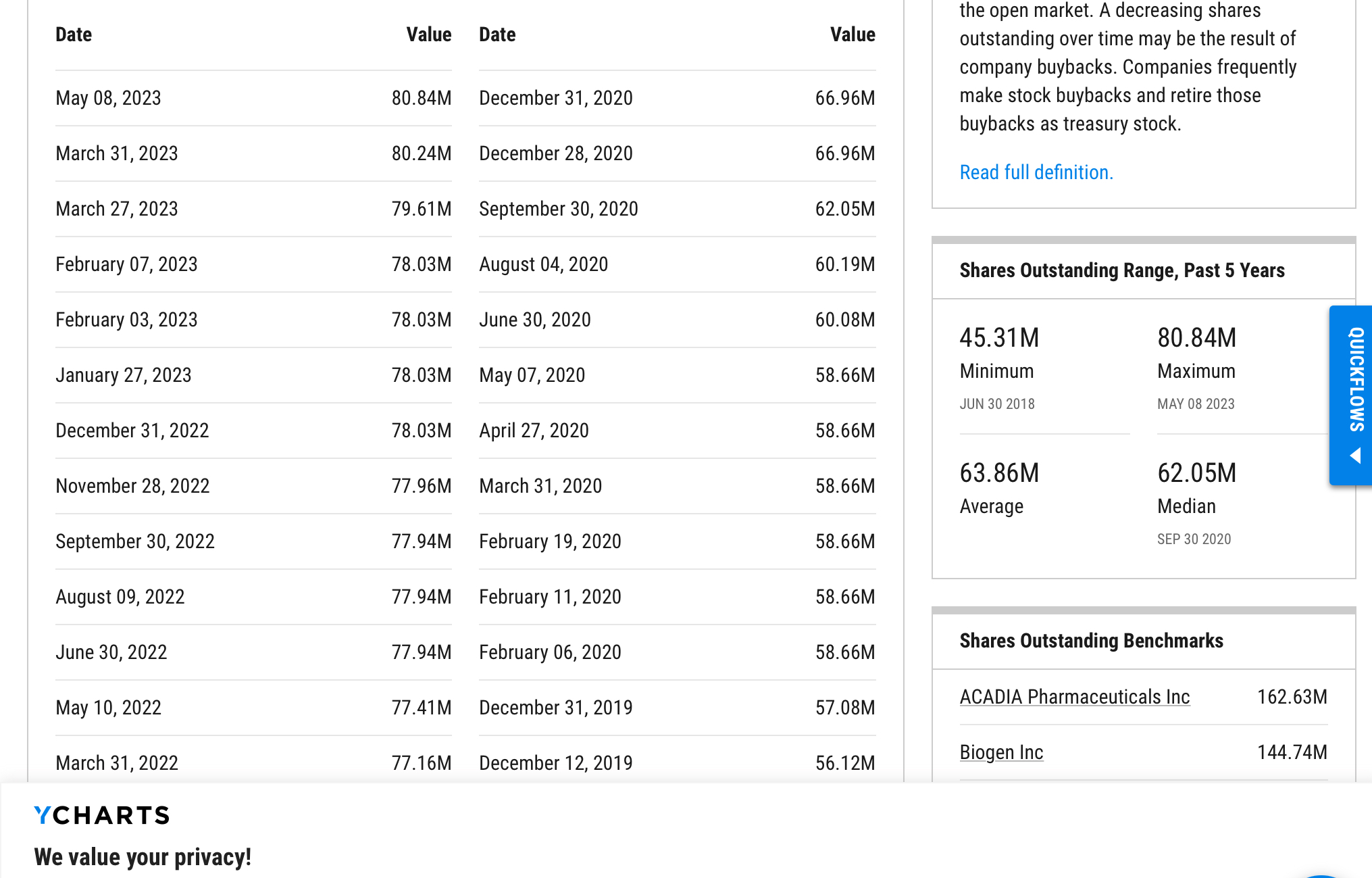
Shares outstanding stiger. Har dobbelte de sidste 5 år.
Man kan jo glæder sig over vi ikke ser emissioner i Anavex, dog vil nogle mene at dette er det samme, det er en lidt mere usynlig måde at øge cashflow. https://ycharts.com/companies/AVXL/shares_outstandingMvh
-
Anavex. Udgivelse vedr. mekanismer af bl.a. 2-73 i AD og PD.
Denne afhandling er ikke Peer Reviewet, men forskerne går dybt ind i de mekanismer, som de mener lægger bag ved udviklingen af Alzheimer og Parkinson - og dermed også hvilke mekanismer en evt. behandling skal kunne påvirke.
Dette er ekstrem langhåret, men især 2-73 synes at stimulerer flere af de mekanismer, de mener er nødvendige for kunne give håb om en effektiv behandling.
Dette fortæller også lidt om, hvor kompleks mekanismerne er i disse CNS indikationer - og giver også en ide om, hvor omfattende en Peer Review fra 2-73 fase 2/3 forsøget kan være og derfor ikke noget man bare lige laver, især når den også skal blåstemples af en 3. Part.Therapeutic Potential of Heterocyclic Compounds Targeting Mitochondrial Calcium Homeostasis and Signaling in Alzheimer's Disease and Parkinson's Disease
Minimum 3 vigtig funktioner 2-73 har en effekt på, som flere og flere mener har en afgørende betydning i behandling af Alzheimer og Parkinson, samt nok mange flere CNS indikationer:
- Modulerer Ca2+ og beskytter mod fejl i Mitchondrial.
- Kontrol af antioxidant og antiinflamation.
- Stimulerer Autophagy funktionen.
"In summary, ANAVEX2-73 interacts with IP3 receptors to modulate Ca2+ release and to prevent mitochondrial failure in multiple ways, including through the activation of the NRF2/ARE pathway that directly controls the expression of several antioxidant and anti-inflammatory genes. In addition, ANAVEX2-73 promotes au- tophagosome biogenesis and autophagic flux to degrade aggregated proteins and dam- aged organelles. Clinical benefits (MDS-UPDRS and CGI-I) have been reported in a 48- week Phase II extension study in patients with PDD (NCT04575259)"
-
BioArctic : Marketing Authorization Application For Lecanemab Submitted In Great Britain
-
Anavex Generalforsamling den 23. maj - MayoMobile deltager.
Som altid - kommer der nogle vigtige nyheder på en GF, så skal der komme en PR i dag eller senest i morgen inden GF afholdes!
Ser frem til om vores gode ven Jesse får fanget Missling og evt. får nogle guldkorn med fra mødet.
Tvivler på at vi får en Peer Review fra AD nu - måske inden AAIC i juli ville være fint og inde for en realistisk tidshorisont.
Vi skal have gang i 2-73 hurtigst muligt - inden Lecanemab gør for meget skade - også nu i Europa. -
Anavex Missling definition på "just around the corner"
En typisk Missling udsagn nok igen på GF i morgen.



Hello! It looks like you're interested in this conversation, but you don't have an account yet.
Getting fed up of having to scroll through the same posts each visit? When you register for an account, you'll always come back to exactly where you were before, and choose to be notified of new replies (either via email, or push notification). You'll also be able to save bookmarks and upvote posts to show your appreciation to other community members.
With your input, this post could be even better 💗
Tilmeld Log ind